
The Story of Bob Ross
Robert Norman “Bob” Ross was born on October 29, 1942, in Daytona, Florida, to Jack and Ollie Ross. His early life was shaped by both practicality and nature. From his father, a carpenter, he experienced hands-on work and craftsmanship, even briefly following that path himself. From his mother, he developed a lasting love and respect for wildlife—an influence that would later become central to his artistic identity. A childhood accident in which he lost part of a finger led him away from carpentry, and in 1960 he chose a different direction, joining the United States Air Force.
It was during his military service that Ross first encountered painting. After being stationed in Florida, he was eventually transferred to Alaska, where the vast natural landscapes made a profound impression on him. The snow-capped mountains, forests, and open skies of Alaska would later become recurring themes in his work. While there, Ross took his first painting lesson at a U.S.O. Club in Anchorage. To supplement his income, he worked as a bartender and sold small landscape paintings on gold prospecting pans to tourists. These early experiences marked the beginning of his lifelong dedication to painting.
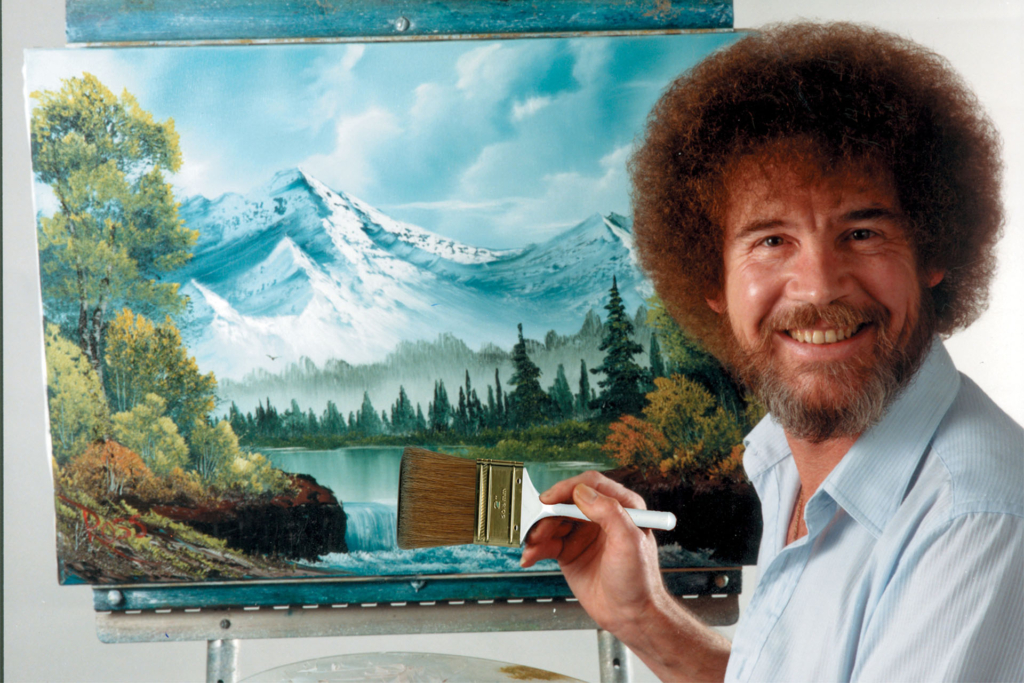
After leaving the Air Force, Ross returned to Florida and pursued further artistic training, attending various art schools and classes. It was during this time that he discovered the “wet-on-wet” painting technique, taught by artist William Alexander. This method, also known as “alla prima” or direct painting, allows artists to complete a painting in a single session by applying wet paint over wet paint without waiting for layers to dry. Ross embraced and refined this approach, eventually developing his own distinctive version along with specialized tools, paints, and techniques designed to make painting more accessible. His adaptation of the technique became a defining feature of his work, allowing him to create complete landscapes quickly and with a sense of spontaneity.
Ross’s passion for sharing art led him naturally into teaching. In 1982, alongside his wife Jane and dedicated friends Walt and Annette Kowalski, they created the Bob Ross Company – first by continuing his in-person painting classes and then launching the Joy of Painting® show on public television.
The show introduced audiences to his calm demeanor, gentle voice, and encouraging philosophy. Ross recorded almost 400 episodes, and over the course of its uninterrupted run from 1982 to today, it has become one of the most recognized and enduring shows in public television history.
What set Bob Ross apart was not only his technique but also his philosophy. He believed deeply that anyone could learn to paint and that creativity was not limited to trained artists.
His approach removed intimidation and replaced it with encouragement. Mistakes, in his view, were simply “happy accidents”—opportunities to adapt and create something new. Through this perspective, he nurtured confidence in his viewers, many of whom found a sense of accomplishment and personal fulfillment through painting. His message extended beyond art, promoting self-acceptance and a positive outlook that resonated with audiences around the world.
Ross’s distinctive presence—his soft voice, relaxed style, and instantly recognizable hair—helped cement his place in popular culture. Though he appeared modest and unassuming, he was also a savvy media personality. He engaged with his audience, shared their successes, and appeared on talk shows, even recording a promotional spot for MTV during its early years. His ability to connect with people across different platforms contributed to the widespread appeal of his work.
Over time, Ross developed a broad and diverse following. His fans span multiple generations, from those who originally watched his show on public television to younger audiences discovering his work through digital platforms. His calming voice and the rhythmic sounds of his brush have even been associated with ASMR (autonomous sensory meridian response), earning him recognition as a figure in the modern wellness movement. Despite changes in media and technology, his work continues to offer a sense of calm and simplicity.
In the digital age, Ross’s popularity has experienced a resurgence. In 2015, a live-streaming marathon of the Joy of Painting® attracted 5.6 million viewers, introducing his work to a new generation and demonstrating the enduring appeal of his approach. This renewed interest highlights the timeless quality of his message. Even as media has evolved from public television to online streaming, the core experience of watching Bob Ross—quiet, focused, and encouraging—remains unchanged.
The legacy of Bob Ross extends far beyond his television series. His influence lives on through his extensive body of work, instructional books, and the global network of Certified Ross Instructors (CRI®s) who continue to teach his methods. His paintings, often featuring mountains, forests, and tranquil landscapes inspired by his time in Alaska, remain widely recognized and frequently imitated.
Many of his original works were donated to the Minnetrista Museum & Gardens in Muncie, Indiana (home of the tiny makeshift studio in which Bob filmed his episodes) where they are viewed and enjoyed by thousands of visitors each year. Minnetrista is currently developing a travelling original painting exhibit that will traverse the country and the world.
In November 2025, an unprecedented fusion of art and public service occurred as thirty original paintings by beloved Joy of Painting® television host and artist Bob Ross were donated to American Public Television in Boston, Massachusetts, slated for public auction through Bonhams Auction House. Auctioning three or four paintings every couple of months, with 100% of its net sales proceeds supporting public television stations nationwide, this historic auction comes at a critical time for public television as it faces recent reductions in federal funding and the demise of the Corporation for Public Broadcasting, a significant financing source. To date, Bob Ross’ paintings have raised over two-million dollars for public television, with still twenty more paintings waiting for their day on the auction block.
“Bob Ross dedicated his life to making art accessible to everyone through public television,” says Joan Kowalski, President of Bob Ross Inc. “This auction ensures his legacy continues to support the very medium that brought his joy and creativity into American homes for decades. I can’t think of a more meaningful way to share his works of art than by supporting public television’s mission to educate and inspire.”
At the heart of Bob Ross’ enduring legacy is a simple but powerful belief: that creativity belongs to everyone. Ross encouraged his viewers to take the first step, to try without fear, and to find joy in the process rather than perfection in the outcome. His warmth, sincerity, and unwavering positivity made him more than a painter or television host—they made him a teacher whose influence continues to inspire millions around the world.
Why Bob Ross Still Matters
Why Bob Ross Still Matters
Bob Ross continues to show up in search results, streaming platforms, and conversations because his work sits at the intersection of creativity and calm.
A Different Kind of Content Experience
In a world where most content is designed to capture and hold attention, Bob Ross’s work stands apart. It does not rely on speed or noise. It moves at a steady pace, allowing viewers to follow along or simply observe.
Why His Work Still Feels Relevant
Bob Ross does not demand attention. He earns it quietly, through consistency, tone, and clarity. That is part of what makes his work timeless.